Every charm factory — including ours — has a set of stories about buyers who paid for lessons they did not need to learn. The mistakes are surprisingly consistent, and almost all of them are avoidable with a five-minute conversation before you order. This is the list we give to buyers at the start of the process, so you can skip the expensive parts of the learning curve.
Mistake 1: Comparing unit price without comparing total cost
The classic trap. Factory A quotes US$0.08/piece, Factory B quotes US$0.12/piece. You pick A, then discover the mold fee is US$600 (double), packaging is extra, and the charms arrive with visible seams.
The fix: compare total landed cost — mold fee + unit price × quantity + packaging + shipping + payment fees. Ask each factory for the same line items. A US$0.12 quote with transparent costs is often cheaper delivered.
Mistake 2: Ordering a custom mold before testing the market
A new design needs a mold (US$80–500), and the mold locks you into that design. Many buyers pay for a full custom mold for a product nobody has tested.
The fix: order stock designs or a simple recolor first (MOQ from 300–500), test the market, and only invest in a custom mold once you know the product sells. The mold cost is a one-time fee, but it is still money spent before revenue.
Mistake 3: Believing a photo is a sample
“Here is a photo of the sample” is not a sample. Photos can be of another factory’s product, an AI render, or the first production attempt that was never quality-checked.
The fix: require a physical sample shipped to you before bulk production. Standard industry practice is 5–7 days for samples. A factory that refuses to send physical samples is telling you something.
Mistake 4: Not checking the material certificate
Charms sold into the EU and North America need REACH and RoHS compliance. Buyers who skip this discover the problem at customs — or worse, after a customer complaint and a product recall.
The fix: ask for the actual certificate documents (not a mention, not a logo) before ordering. We supply ours with samples. If a factory hesitates, that is a red flag.
Mistake 5: Assuming the mold is yours
Some factories quote a low mold fee and keep ownership, which means your next order — even a reorder of the same design — requires their mold. You are locked in.
The fix: confirm mold ownership in writing before paying. You should own the mold or have explicit rights to move it to another factory. We state ownership on every quote.
Mistake 6: Forgetting the pin-back is part of the product
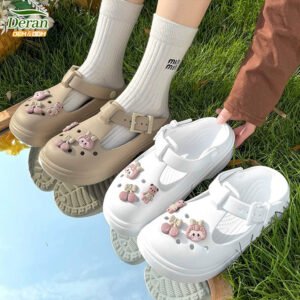
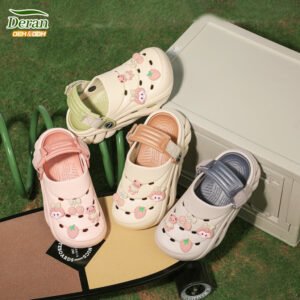
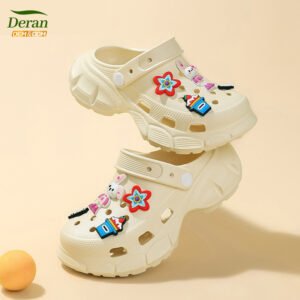
A charm that looks great but pops out of the shoe is a returned product. The pin-back — the little post that clicks into the ventilation hole — is where cheap production fails.
The fix: test the pin-back retention on the physical sample: snap it into a shoe and pull. The charm should hold firmly and release without breaking. Ask the factory about their pin-back QC process.
Mistake 7: Ignoring packaging until the end
Your charms arrive in poly bags with no brand, your retail packaging plan fails, and you pay rush fees for boxes. Packaging decisions made at the last minute cost money.
The fix: decide packaging up front — poly bag, header card, or custom box. Custom packaging adds 5–7 days to the timeline; factor it into your schedule, not as an afterthought.
Mistake 8: Planning the timeline backward from the wrong date
“Can you deliver in 2 weeks?” is the most common question we hear, and the honest answer is no. Samples take 5–7 days, bulk 10–15 days, sea freight 25–40 days.
The fix: plan 8–10 weeks from order to US/EU warehouse by sea (6–8 if air freight). Backward-plan from your event or sale date. Buyers who start early are the ones who never miss a season.
The checklist to send any factory
Copy this into your inquiry — it covers everything above in one message:
- Are you a factory? Can we video-call the floor?
- Do you send physical samples before bulk? How long?
- What are your REACH/RoHS certificates?
- What is the mold fee, and do I own the mold?
- What is your pin-back retention QC process?
- What is your defect rate and replacement policy?
- What packaging options do you offer, and what is the timeline impact?
- What is the total landed cost breakdown?
FAQ
How do I know a charm factory is real?
Ask for a video call inside the factory, physical samples shipped to you, and certificate documents. Real factories do all three without hesitation.
What is the biggest scam in charm sourcing?
“Free mold” offers. The mold cost always comes back — either in a higher unit price or locked-in reorders. Transparent factories quote both separately.
Do I need a trademark license to make charms?
Designs and trademarks are the buyer’s responsibility. If your design includes a brand or character, confirm you have rights before ordering.
What is the minimum quantity to test the market?
Stock designs: 300–500 pieces. Custom with your logo: 500–1,000. Start small, test, then scale.
Related reading: How much do custom croc charms cost · Custom croc charms hub · How charms are made
Deran (clogsslipper.com) has manufactured footwear and accessories in Quanzhou, China since 2005. We produce custom croc charms, slippers, and clogs under OEM/ODM — physical samples before bulk, transparent quotes with mold cost and unit price listed separately, REACH/RoHS certified, defect rate below 1%. Send us your design for a quote — we reply within 24 hours.
发布说明:避坑内容基于行业常见问题与工厂实际操作流程。