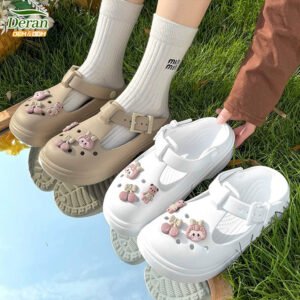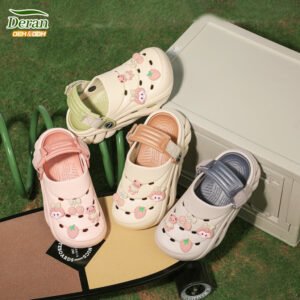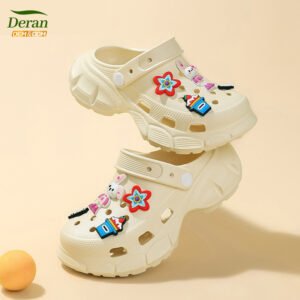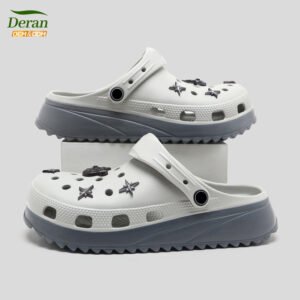
Most charm listings online show you a finished product and a price. Nobody shows you what happens between “we received your logo” and “your charms arrive at the warehouse.” That gap matters, because the quality of a charm — the crispness of the logo, the feel of the plastic, whether the pin-back snaps cleanly into a shoe — is decided in the workshop, not in the sales chat.
We have run a footwear and accessories factory in Quanzhou, China since 2005. Charms are one of our smaller product lines compared to slippers and clogs, but they are the line where design detail shows up fastest. This is a walk through our actual production floor, written so you can use it as a checklist when you evaluate a supplier.
Step 1: Design and file preparation
Every charm starts as a 2D drawing or logo file. What we need from you:
- Vector file (AI, EPS, PDF, CDR) — best for sharp edges and clean molding. A high-resolution PNG works if vector is not available.
- Size specification — a standard charm is 20–40 mm wide. We can go smaller or larger, but staying in the standard range keeps costs down.
- Color reference — Pantone codes if you are picky; otherwise our colorist matches from photos.
A good factory will tell you honestly whether your design will mold well. Thin details under about 0.8 mm, for example, may not fill properly in PVC injection. We redraw and simplify the design with you before any mold work happens. This stage costs nothing and saves everyone money later.
Step 2: 3D modeling and mold making
The approved design goes to a mold maker. For a flat 2D charm, the mold is a steel plate with the design engraved — this is the US$80–500 tooling cost you see on quotes. For a 3D or sculpted charm, the mold is cut from steel on a CNC machine, which takes longer and costs more.
Two things separate good molds from cheap ones:
- Steel quality and finish. Polished mold surfaces transfer to smooth charm surfaces. Rough molds produce rough edges that show up as white lines after trimming.
- Ejection design. A well-designed mold releases each charm cleanly. Poorly designed molds damage the pin-back on removal, which you only discover when your customer complains that half the charms fall out of their shoes.
Mold making takes 5–7 days for typical 2D designs. We photograph every new mold and send the photos with the sample.
Step 3: Material mixing
PVC charms start as PVC resin pellets combined with plasticizers and color masterbatch. The mix is heated until it flows, then injected into the mold under pressure.
What most buyers never see: recycled versus virgin material. Recycled PVC is cheaper and looks fine for a while, but it yellows faster, is more brittle, and has inconsistent color between batches. Reputable factories state their material policy clearly. We use virgin pellets and can show the material certificates.
If your charm is the “photo bubble” style, this step changes: a printed image is placed into the mold and clear resin is poured over it. That is why epoxy charms cost more — two materials, two process steps.
Step 4: Injection, cooling, and trimming
The hot PVC is injected into the mold, cooled for a few seconds, and ejected. Then comes the part nobody photographs: trimming. Every charm comes out of the mold with a thin flash line where the mold halves meet. A worker trims it by hand — or a good worker trims it carefully.
Hand trimming is where quality differences become visible:
- Cheap factories rush this step. You get charms with rough edges, visible seams, and scratches.
- Our standard is a smooth edge with no visible seam line on the face of the charm. It takes longer per piece, which is one reason our unit price sits above the cheapest Alibaba listings.
Step 5: Quality control and pin-back testing
Every batch goes through checks before packing:
- Visual inspection — color match against the approved sample, surface defects, incomplete fill.
- Pin-back test — a sample of charms is snapped into an actual shoe with the standard hole pattern and pulled to check retention. A charm that pops out easily fails.
- Count and pack — charms are counted by weight or by machine counter, then packed in poly bags, header cards, or custom boxes.
We quote a defect rate below 1% and replace defective pieces on the next order. That is not an industry default — it is worth asking your supplier for their actual number.
What to check when your samples arrive
You will not be on the production floor, but you can evaluate a factory from its samples:
- Run your fingernail along the edge. Rough or sharp edges mean trimming was rushed.
- Hold the charm up to light. Translucent, patchy, or streaky areas indicate poor material or mixing.
- Snap it into a shoe and pull. The pin should hold firmly but come out without breaking the pin or the shoe hole.
- Compare two samples from the same batch. They should be identical in color and finish. Variation means poor process control.
- Ask for the material certificate (REACH, RoHS) — not a photo of a logo, but the actual certificate document.
How long does the whole process take?
From file approval to charms in hand, plan for:
- Mold + sample: 10–14 days
- Bulk production: 10–15 days after sample sign-off
- Sea freight to the US/EU: 25–40 days; air freight: 5–10 days
Total from first contact to delivery is usually 6–9 weeks for a sea-freight order. If a factory promises production in under two weeks including samples, ask how — it usually means they are skipping the sample stage or the QC stage, and one of those will cost you.
FAQ
What is the minimum order for custom charms?
Custom 2D charms typically start at 500–1,000 pieces; 3D or sculpted designs start higher (1,000–3,000). Stock designs can be ordered in as few as 300 pieces.
Are your charms compatible with Crocs and similar clogs?
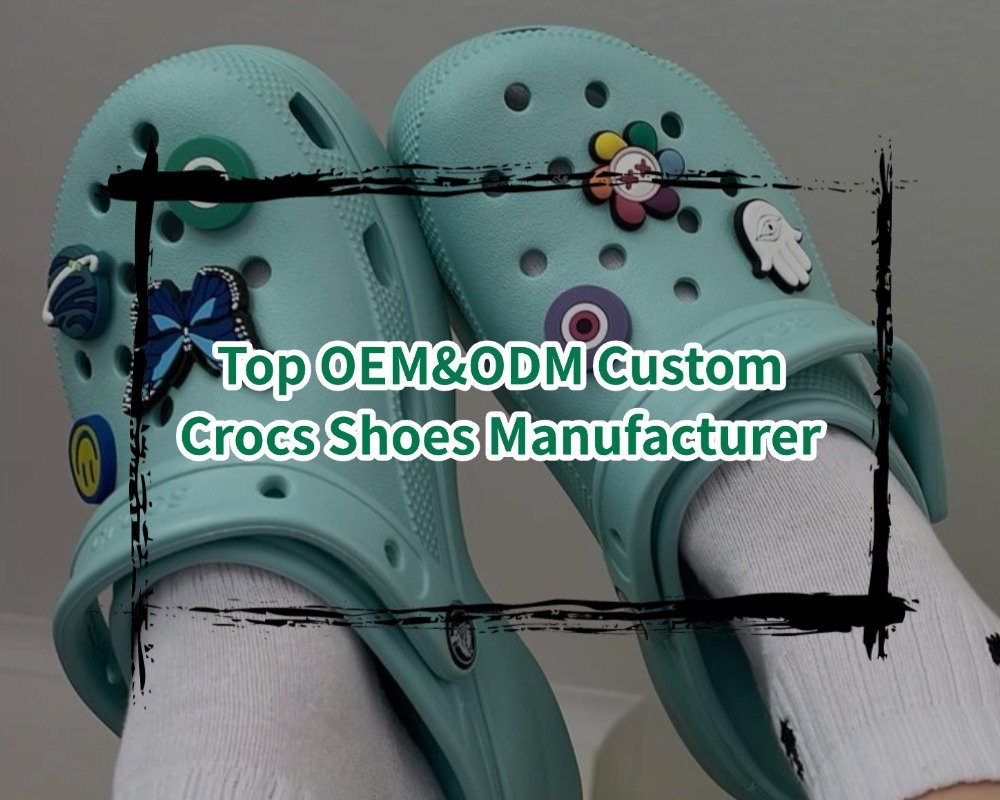
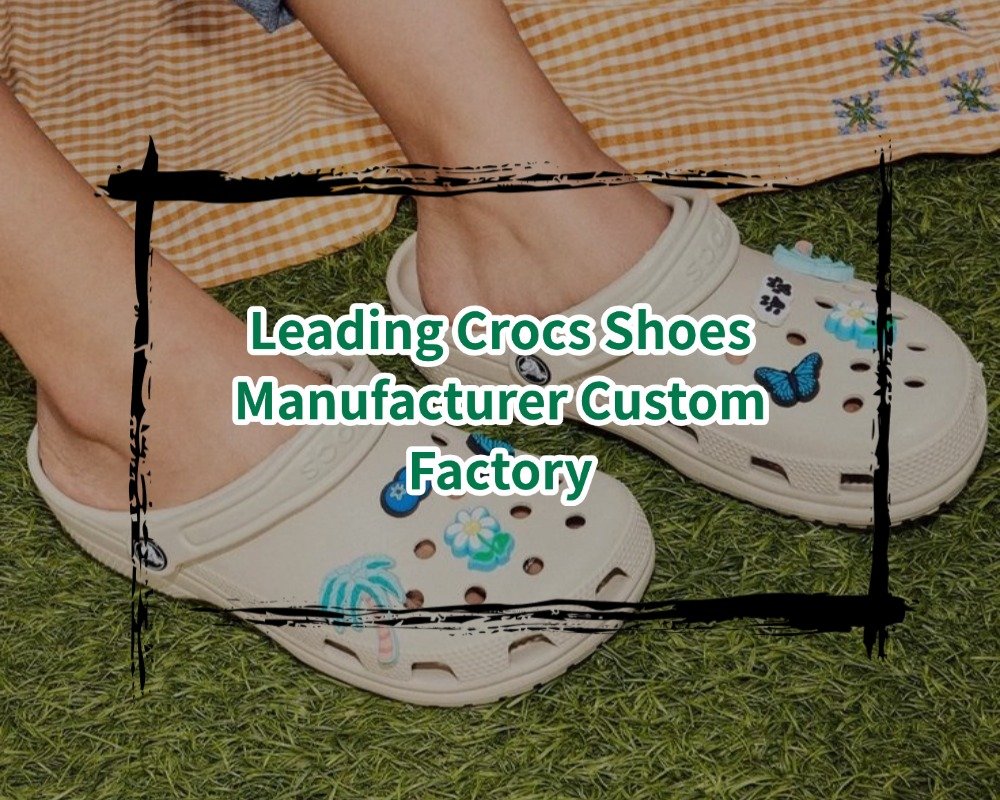
Yes — we manufacture to the standard ventilation-hole pin size used across the industry, so they fit Crocs, slides, and most clog-style shoes with the same hole pattern.
Can you produce charms with photo-quality printing?
Yes, in the epoxy dome style. The printed image sits under a clear resin dome, which protects it from scratches.
Do you offer custom packaging?
Yes: poly bags, header cards, and printed boxes. Packaging adds 5–7 days to the timeline.
Can I visit the factory?
We welcome factory visits and video calls. Seeing the floor is the fastest way to answer the quality questions in this article.
Related reading: How to source custom croc charms wholesale · Custom croc charms & jibbitz wholesale
Deran (clogsslipper.com) has manufactured footwear and accessories in Quanzhou, China since 2005, running 4 production lines in a 4,000 m² facility with a monthly capacity of 400,000 pairs. Alongside custom croc charms, we produce EVA slippers, clogs, flip-flops, and fur slippers for brands worldwide. Send us your design for a sample quote — we reply within 24 hours.